Thursday, 6 October 2011

2.4 angle properties in polygons

key idea....


  • you can prove properties of angles in polgons using other angle properties that have already been proved


need to know


  • the sum of the measures of the interior angles of a convex polygon with N sides can be expressed as 180 degrees(n-2)

  • the measure of each interior angle of a regular polygon is 180 (n-2)

_____


n


  • the sum of the measures of the exterior angles of any convex polygon is 360 degrees

ex: if a polygon has 15 sides what is the sum of the interior angles


answer: 15-2=13


13x180=2340


2340/15=156


answer is 156


next is sarah donald!!!

this is finally my post :)

Monday, 3 October 2011

Angle Properties in Polygons


we learned how to find the sum of interior angles using (s-2)180. This only works with convex polygons not concave, to be convex no angles can be bigger than 180


We also learned about the sum of exterior angles, as shown in the diagram below
w=180-A
x=180-b
y=180-c
z=180-d
s=w+x+y+Z = (180-a)+(18o-b)+(180-c)+(18o-d)= 720-a-b-c-d
720 -1(a+b+C+D)
720-360= 360
this is how we found out the exterior angle sum for this 4 sided figure.

Math 20 Foundations Exam


This week will be a busy week in Math Foundations 20.

On Wednesday, Oct. 5 we will write a Practice Exam for Chapter 2.

On Thursday we will be in the Writing Lab. We will work on our Logo Design Assignment (Chapter Task 2) and also select a topic for our Course Project. The Logo Design task is due on Tuesday after the long weekend, October 11.

On Friday, October 7 we will be writing the Chapter 2 Exam.

Have a great week. If you need any extra help, come and see me!

Long-Awaited Thursday Post (Now With More Friday!)


On Thursday, the class didn't do much. We took sheets of paper and drew straight lines from two of the vertices to a point on the opposite side of the paper, then cut them out, creating two right triangles and one acute triangle (Oooh facinating). We noticed that when we put the two right angled triangles on the bigger accute triangle, they matched up the same. Using our knowledge of supplementary and alternate angles, we were able to figure that the sum of the interior angles of any triangle equals 180 degrees (Wow what magic!)
On Friday we talked about non-adjacent interior angles (Sounds fun)! Non- adjacent Interior Angles are two angles of a triangle that do not have the same vertex as an exterior angle. In the picture, angle X and angle Y are non-adjacent interior angles to angle Z! We discovered that the measure of an exterior angle of a triangle is equal to the sum of the measures of the two non- adjacent interior angles (which is pretty cool because it shows the neat relations between the sides of a triangle!). We had an assignment to do and it was page 90, #1-3, 5, 6, 8, 9, and 12! Big assignment, but I'm sure we all got it done, RIIIIIGHT??


Next up is Colby!!

Friday, 30 September 2011

Mid-Chapter Review


We started the class off by reviewing a few questions from our previous assignment. We also reviewed that proofs need to be based on facts. For example if two parallel lines are cut by a transversal, and we need to prove that angle  d is 73°, we would say that angle c is 107° because it is the corresponding angle to the one labeled 107°. Next we would say that since angle d is supplementary to c, and c is 107° therefore angle d is 73° because supplementary angles must add up to 180°.

  We then got into groups where each group was assigned a question from the mid-chapter review from pg. 84. We were to answer the question we were given, and then show and explain our work on the overhead projector. Since it was a half day and we did not have time for anything else, we dispersed joyfully when the lunch bell rang. A diagram has been provided to accurately represent the level of joy.
The next to post in the blog will be Tanner.

Monday, 26 September 2011

Angles Formed by Parallel Lines

We started off class by looking over our Chapter 2 diagnostic work sheet and correcting a classmates to show Mr.Banow our knowledge in this unit so far.


Converse is a statement that is formed by switching the premise and the conclusion of another statement.


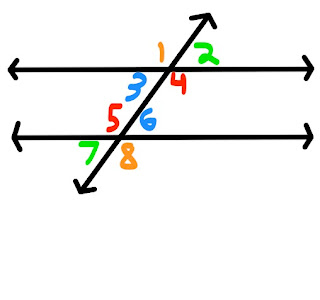
Next we worked on page 72 which is reviewing parallel lines and transversals.


We reviewed what Alternate Interior and Exterior angles were.

Alternate interior angles are two non-adjacent interior angles on opposite sides of a transversal. Which is angles 3,6 and 4,5.

Alternate exterior angles are two exterior angles formed between two lines and a transversal, on opposite sides of the transversal. Which is angles 1,8 and 2,7.


We also reviewed what Supplementary and Complementary angles were. Two angles are Supplementary angles if they add up to 180 degrees. These two angles (140 degrees and 40 degrees) are Supplementary Angles, because they add up to 180 degrees. These two angles (40 degrees and 50 degrees) are Complementary Angles, because they add up to 90 degrees.


The next person to blog will be, AARON. :)


OH YAH, and don't forget to bring a compass, protractor and ruler ASAP.